VortexAccel VortexAccel

How to Choose an Industrial AI Server Manufacturer in 2026?

Time:2026-10-14 Author:Madeline
0%

Choosing an industrial AI server manufacturer in 2026 requires more than comparing processor counts and storage capacity. Factory environments expose weak systems quickly. Heat, vibration, dust, network delays, and continuous workloads can reveal design flaws within months.

Jensen Huang, NVIDIA’s founder and a leading AI infrastructure expert, has said, “The more you buy, the more you save.” This famous line should not guide purchasing alone. Lower prices may hide higher cooling costs, limited warranties, or expensive software support. A reliable industrial AI server manufacturer must explain total ownership costs clearly, including power consumption, maintenance, upgrades, and deployment time.

Look for evidence from real industrial installations. Ask whether the supplier has supported machine vision, predictive maintenance, robotics, or edge analytics in demanding facilities. Request measurable details, such as inference latency, operating temperature ranges, GPU availability, and failure rates. A polished brochure is not enough.

Technical expertise matters. The manufacturer should help match GPUs, CPUs, memory, networking, and rugged chassis designs to your workload. It should also provide lifecycle planning, remote monitoring, spare parts, and responsive engineering support. Certification and cybersecurity practices deserve careful review.

Some buyers still choose the biggest brand automatically. That can be a mistake. Large vendors may offer strong resources, but smaller specialists may provide faster customization. Neither option is always better. The right decision depends on workload stability, site conditions, budget, and future expansion.

This guide examines the practical questions behind that decision. It also challenges common assumptions, because the cheapest server is rarely the cheapest system to operate.
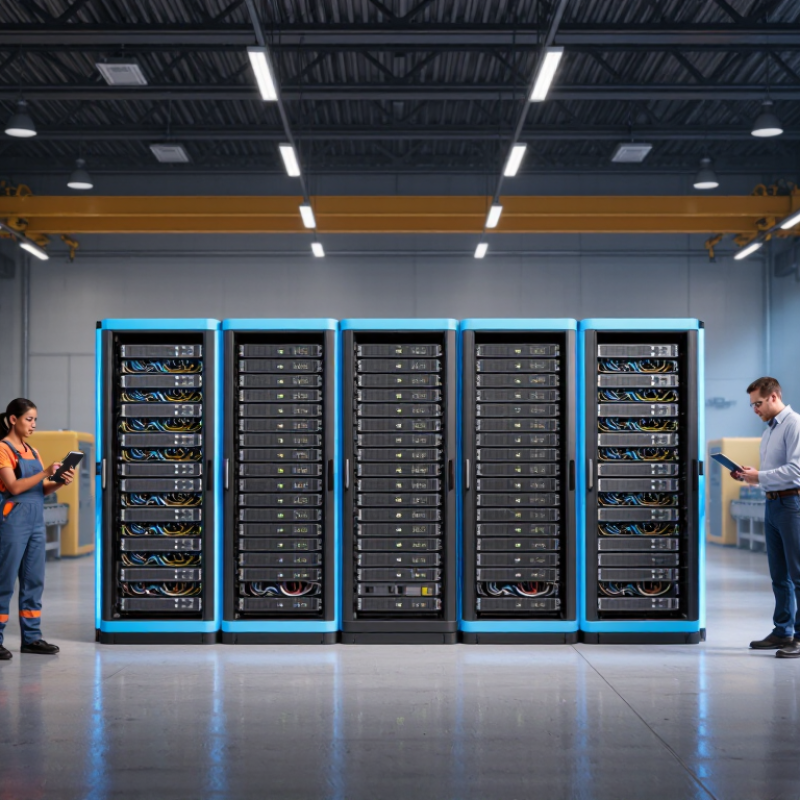
How to Choose an Industrial AI Server Manufacturer in 2026?

What an Industrial AI Server Manufacturer Provides in 2026

An industrial AI server manufacturer in 2026 provides more than a rack-mounted computer. It delivers a complete platform for factory, energy, transport, and inspection environments. Engineers should expect GPU or accelerator options, industrial-grade processors, high-speed networking, and storage designed for continuous workloads.

The chassis may need dust protection, vibration resistance, and stable operation beside noisy production equipment. Small details matter. Cable routing, service access, and cooling design can reduce maintenance time.

A reliable manufacturer also provides validated hardware and software combinations. These may include container support, device monitoring, remote management, and tools for model deployment at the edge.

Ask for measured inference performance, not attractive theoretical figures. Request test results under realistic temperatures, workloads, and network conditions.

Security features should include controlled access, firmware protection, logging, and timely update procedures.

Documentation must explain installation, diagnostics, spare parts, and expected component life. Without these details, technical promises remain difficult to verify.

Practical support is equally important. A capable supplier can help size the server, integrate cameras or sensors, and configure redundant power or storage. It should offer training and responsive technical assistance after delivery.

However, no manufacturer will solve every deployment problem. Poor sensor placement, weak data quality, or unrealistic latency targets can still damage results.

I have seen projects focus heavily on accelerator capacity while ignoring heat, noise, and maintenance space. That mistake is expensive.

Before choosing a supplier, inspect its testing process, talk with service engineers, and request a pilot using your own industrial data. Tests reveal gaps.ેણ

Which Industrial AI Workloads and Hardware Specifications Matter Most

How to Choose an Industrial AI Server Manufacturer in 2026?

Industrial AI workloads should guide the server choice, not attractive specifications alone. A camera inspection line may process four video streams per second, while predictive maintenance analyzes vibration, temperature, and motor current. These tasks need different inference capacity, memory, and storage. Start with actual data rates, model sizes, response targets, and operating temperatures.

For real-time vision, prioritize a capable GPU or accelerator, fast PCIe connectivity, and sufficient video memory. Eighty-five percent GPU usage may look efficient, but it leaves little room for model updates or sudden workload spikes. Predictive maintenance often benefits from strong CPU performance, ECC memory, and rapid NVMe storage. Digital twin workloads may require more RAM than expected. Measure it.

The factory environment changes the hardware decision. Check fan design, dust protection, vibration resistance, thermal limits, and remote management features. A server placed beside a furnace needs a different cooling strategy than one installed in a clean control room. Dual power supplies and redundant storage can reduce costly interruptions. Network options also matter, especially for low-latency connections between sensors and inference servers.

I once focused too heavily on accelerator performance and underestimated maintenance access. That mistake increased downtime during a simple component replacement. Ask manufacturers for workload testing with your models, not generic benchmark charts. Request failure-rate data, firmware support periods, repair procedures, and documented compliance evidence. Their answers reveal reliability better than a polished product sheet.

How to Choose an Industrial AI Server Manufacturer in 2026? – Which Industrial AI Workloads and Hardware Specifications Matter Most
Industrial AI Workload Typical Use Case Recommended AI Hardware Key Hardware Specifications Important Performance Metric Deployment Priority Manufacturer Evaluation Criteria
Real-Time Machine Vision Defect detection, dimensional inspection, optical character recognition, and assembly verification on production lines. Edge AI server or compact industrial GPU server 1–2 accelerator devices;
16–64 GB system memory;
NVMe SSD storage;
2.5/10 GbE networking;
hardware support for camera interfaces where required.
End-to-end latency below 50–100 ms, stable frames per second, and consistent inference under continuous operation. Critical Validated camera compatibility, deterministic response, low acoustic output, dust-resistant design, and easy access for maintenance.
Predictive Maintenance Failure-risk prediction using vibration, temperature, current, pressure, acoustic, and maintenance-history data. CPU server for feature engineering and inference; accelerator optional for deep-learning models 16–128 CPU cores;
64–256 GB ECC memory;
redundant NVMe or enterprise SSD storage;
time-series database support;
industrial I/O or gateway integration.
Data-ingestion rate, forecast accuracy, alert lead time, and availability of the complete monitoring pipeline. High ECC memory, long-life components, storage redundancy, sensor protocol support, and reliable operation with intermittent connectivity.
Digital Twin and Simulation Process simulation, virtual commissioning, production-flow optimization, and physics-informed model execution. High-memory compute server with one or more professional accelerators 32–128 CPU cores;
256 GB–2 TB ECC memory;
2–8 accelerator devices depending on model size;
high-speed local NVMe scratch storage;
25/50/100 GbE for shared workloads.
Simulation time per scenario, solver throughput, memory bandwidth, and scaling efficiency across accelerators. High High memory capacity, thermal headroom, validated simulation software, high-speed interconnects, and support for sustained workloads.
Generative AI for Industrial Knowledge Maintenance assistants, engineering document search, work-order summarization, and retrieval-augmented generation. GPU server for local inference or hybrid on-premises deployment 1–4 accelerators;
64–512 GB system memory;
accelerator memory sized to the model and quantization method;
fast NVMe storage for indexes;
10/25 GbE networking.
Time to first token, tokens per second, concurrent-user capacity, retrieval latency, and response consistency. High Secure local deployment, model-serving compatibility, data-isolation controls, upgradeable accelerator capacity, and quantized-model support.
Industrial Forecasting Demand forecasting, energy-load prediction, inventory planning, and production-capacity optimization. CPU-dense server with optional accelerator support 16–64 CPU cores;
64–256 GB ECC memory;
redundant SSD storage;
database and container support;
10/25 GbE networking.
Forecast error, batch-processing time, data-refresh interval, and performance across multiple time-series datasets. Medium Strong multi-core performance, memory capacity, virtualization support, reliable storage, and compatibility with existing data platforms.
Robotics and Autonomous Control Robot perception, path planning, sensor fusion, autonomous mobile equipment, and collaborative-robot safety functions. Low-latency edge server or ruggedized embedded AI system 1–2 low-power accelerators;
16–64 GB ECC or industrial-grade memory;
hardware time synchronization;
real-time operating-system compatibility;
CAN, TSN, serial, or other required industrial interfaces.
Control-loop latency, jitter, sensor-fusion latency, safe-state response time, and uptime during motion. Critical Deterministic networking, real-time support, vibration resistance, wide-temperature operation, functional-safety integration, and secure boot.
Large-Scale Model Training Training computer-vision, language, multimodal, and industrial foundation models using centralized datasets. Multi-accelerator training server or cluster 4–8 or more accelerators;
256 GB–2 TB ECC memory;
high-bandwidth accelerator interconnect;
100/200 GbE or higher cluster networking;
parallel or high-throughput storage.
Training time to target accuracy, accelerator utilization, scaling efficiency, data-loader throughput, and checkpoint time. High Power delivery, cooling capacity, accelerator compatibility, cluster-management support, serviceability, and transparent performance testing.
Video Analytics and Worker Safety Restricted-area detection, personal protective equipment recognition, traffic monitoring, and incident review. Edge GPU server with multiple video-input pipelines 1–4 accelerators;
32–128 GB memory;
storage sized for retention requirements;
10/25 GbE networking;
support for the required video codecs and streams.
Concurrent video streams, inference latency, detection precision and recall, storage-retention period, and network bandwidth. Critical Stream-density benchmarks, privacy controls, secure remote management, video retention options, and reliable operation in industrial environments.
AI Data Preparation and Analytics Data cleaning, labeling, feature generation, model evaluation, and preparation of sensor and image datasets. CPU-dense server with high memory and fast storage 32–96 CPU cores;
128–512 GB ECC memory;
high-capacity NVMe storage;
25/50 GbE networking;
container and orchestration support.
ETL throughput, dataset-query latency, storage IOPS, memory utilization, and time required to produce training-ready data. High Memory expandability, storage scalability, open software support, container compatibility, and simple integration with data lakes.
Private AI Inference at Scale Serving computer-vision, forecasting, language, and optimization models across multiple factories or production cells. Redundant GPU or accelerator server cluster 2–8 accelerators per node;
128–512 GB ECC memory;
redundant power supplies;
hot-swappable storage and fans where available;
25/100 GbE networking.
Requests per second, p95/p99 latency, service availability, failover time, and cost per inference. Critical High availability, remote out-of-band management, lifecycle support, security updates, workload orchestration, and documented service-level commitments.
Practical selection rule: prioritize latency and deterministic operation for control and inspection workloads; prioritize memory capacity, accelerator bandwidth, and network throughput for simulation, training, and large-scale inference.

How to Evaluate Performance, Reliability, and Industrial Compatibility

Choosing an industrial AI server manufacturer in 2026 requires more than comparing processor names. Performance should match your real workload, not an attractive laboratory benchmark. Ask for results using your camera streams, sensor rates, model sizes, and required response times. Measure inference latency, sustained throughput, power consumption, and performance during thermal throttling. Test it live.

Reliability appears in small engineering details. Check ECC memory, redundant power options, storage protection, cooling design, and remote health monitoring. Review operating temperature, vibration tolerance, dust protection, and expected service life. A factory server may run beside motors, heat, and electrical noise. Request failure-rate data and repair procedures, but treat every figure carefully. Field experience often reveals weaknesses that brochures omit.

Industrial compatibility deserves equal attention. The server should support your operating system, container platform, industrial protocols, time synchronization, and existing PLC or SCADA connections. Confirm driver stability for accelerators and verify long-term software support. Ask whether technicians can replace fans, drives, or power supplies without extended downtime. I would also inspect one production unit, not only a demonstration model. A perfect benchmark does not exist. Your evaluation may still miss seasonal heat, network interruptions, or future model growth. Build a pilot with recorded workloads, define acceptance limits, and document every failure before signing a supply agreement.

How to Compare Security, Scalability, Support, and Total Cost

How to Choose an Industrial AI Server Manufacturer in 2026?

Choosing an industrial AI server manufacturer in 2026 requires more than comparing accelerator counts. Security must be tested at the rack, firmware, network, and operator levels. Ask for signed firmware, secure boot, vulnerability disclosure timelines, and auditable access logs. The 2024 Cost of a Data Breach Report places the average breach cost at $4.88 million. That figure is not a factory forecast, but it changes the purchasing conversation. Request evidence, not reassuring slides. A clean checklist can still miss a careless administrator.

Scalability means more than adding servers. Review GPU availability, thermal headroom, power density, orchestration support, and sensor compatibility. Require performance tests using your models, data rates, and worst-case temperatures. Uptime Institute’s 2024 Global Data Center Survey reported that 54% of operators experienced an outage during the previous three years. Ask how failover works when a cabinet loses power. Also check spare-part locations and replacement targets. “Worldwide support” means little at 2 a.m. if escalation stays theoretical.

Support should include named engineers, remote diagnostics, firmware maintenance, training, and documented service-level commitments. Compare five-year total cost, including electricity, cooling, licenses, integration labor, downtime exposure, and decommissioning. The IEA’s Electricity 2024 report estimates that data centers consumed about 460 TWh globally in 2022, potentially exceeding 1,000 TWh by 2026. Get three scenarios: expected, rapid growth, and delayed deployment. My own preference is a slightly slower platform with clearer recovery procedures. I have regretted buying peak performance before proving operational fit.

How to Select and Verify the Right Manufacturer for Your Facility

Choosing an industrial AI server manufacturer begins with your facility, not a brochure. Map camera count, sensor protocols, rack space, ambient temperature, dust, vibration, and power limits. Ask the manufacturer to test your exact workloads, including peak inference and storage traffic. A server that performs well in a clean showroom may throttle beside a furnace. Request thermal logs, component life estimates, and clear operating ranges. Keep these records with your procurement file.

Verification should combine documents and physical evidence. Check quality-system certifications, product traceability, firmware control, and cybersecurity update procedures. Ask for serial-level test reports, not generic compliance claims. Confirm recognized safety and electromagnetic compliance for your region. Visit the production site when possible. Inspect burn-in stations, cable labeling, repair procedures, and failure records. Speak with two comparable facilities. Ask how quickly replacement parts arrived during an outage. A polished demo proves little.

Use a staged acceptance test before full deployment. Run your models on representative data, then measure latency, accuracy, power draw, noise, and recovery after a forced restart. Confirm remote support hours, spare-part stock, warranty boundaries, and end-of-life notice periods. Put every promise into the contract. No checklist is perfect. Teams still miss hidden network delays or poor documentation. Recheck those details with an independent engineer before installation.

How to Choose an Industrial AI Server Manufacturer in 2026?

Use a documented, weighted evaluation rather than relying only on processor specifications. The model below prioritizes cybersecurity, validated AI performance, lifecycle support, reliability, integration, compliance, serviceability, and total cost of ownership.

How to apply it: Request objective evidence for each category, including security documentation aligned with IEC 62443 or ISO/IEC 27001 practices, workload-specific AI benchmark results, component availability commitments, thermal test data, operating-system and software compatibility, relevant conformity documentation, repair procedures, and a five-year ownership estimate. The percentages are a transparent procurement weighting model and should be adjusted to match the facility’s risk, workload, and operating environment.

FAQS

How should an industrial AI server be selected?

Start with real workloads, data rates, model sizes, response targets, and operating temperatures. Measure twice.

What hardware matters most for real-time camera inspection?

Choose a strong GPU or accelerator, fast PCIe connectivity, and enough video memory. Leave headroom. Eighty-five percent usage may not handle sudden workload spikes or model updates.

Which hardware suits predictive maintenance systems?

These systems often need strong CPU performance, ECC memory, and fast NVMe storage. They process vibration, temperature, and motor-current data continuously.

Do digital twin workloads require special planning?

Yes. Digital twins may consume more RAM than expected during detailed simulations. Test actual models instead of trusting estimated memory requirements.

How does the factory environment affect server selection?

Check cooling, dust protection, vibration resistance, thermal limits, and maintenance access. A server beside a furnace needs stronger thermal planning than one in a clean room.

Which reliability features can reduce production interruptions?

Dual power supplies, redundant storage, remote management, and suitable network connections can improve recovery. Also inspect spare-part locations and replacement targets.

What security evidence should a manufacturer provide?

Request signed firmware, secure boot, vulnerability response timelines, and auditable access logs. Evidence matters more than polished slides. Administrators still create risks.

How should scalability be tested before purchase?

Test your models, sensor rates, worst-case temperatures, power limits, and expected future growth. Review GPU availability, thermal headroom, orchestration support, and sensor compatibility.

What should industrial support services include?

Look for named engineers, remote diagnostics, firmware maintenance, training, and clear service-level commitments. Ask how escalation works during overnight failures.

How should total cost be compared?

Calculate five-year costs for electricity, cooling, licenses, integration labor, downtime, and decommissioning. Create expected, rapid-growth, and delayed-deployment scenarios. Peak performance is not always the best value.

Conclusion

Choosing the right industrial ai server manufacturer in 2026 requires more than comparing processing power. A suitable manufacturer should provide complete AI server solutions designed for demanding industrial environments, including hardware configuration, deployment guidance, system integration, and long-term maintenance. Buyers should first identify their workloads, such as computer vision, predictive maintenance, robotics, digital twins, or real-time analytics, then evaluate processors, accelerators, memory, storage, networking, and expansion options that match those requirements.

Performance must be assessed alongside reliability, thermal management, ruggedness, industrial compatibility, and continuous operation. Security features, remote management, scalability, technical support, warranty coverage, energy efficiency, and total cost of ownership are equally important. Before making a decision, organizations should verify certifications, testing procedures, delivery capabilities, customization options, customer references, and service responsiveness. A structured comparison and facility-specific validation process can help ensure the selected manufacturer delivers a dependable, secure, scalable, and cost-effective platform for long-term industrial AI deployment.

Madeline

Madeline

Madeline is a dedicated marketing professional with a wealth of expertise in our company's core offerings. With a keen understanding of the industry, she brings a unique perspective to her role, consistently delivering high-quality content that highlights the superior aspects of our products. As......