 VortexAccel
VortexAccel
VortexAccel
Choosing an AI server supplier in 2026 requires more than comparing GPU counts. Buyers must examine performance, reliability, service coverage, and long-term operating costs.
This guide evaluates top ai server manufacturers through practical purchasing questions. Can the system support current NVIDIA or AMD accelerators? Does its chassis provide enough airflow for sustained training loads? Can engineers replace a failed power supply without disrupting an entire rack? These details matter in real data centers, where heat, noise, cable density, and maintenance windows shape daily operations.
Jensen Huang, NVIDIA’s founder and CEO, has stated, “The future of computing is accelerated computing.” That view helps explain the rapid demand for GPU servers, but it does not make every manufacturer equally suitable. A powerful specification sheet can hide weak firmware support, limited regional service, or expensive replacement parts. This is where many buying guides remain too optimistic.
The following comparison considers established server brands, specialist AI infrastructure companies, and flexible system integrators. It reviews GPU compatibility, CPU balance, memory capacity, networking, liquid-cooling options, security controls, warranties, and deployment experience. It also considers regional availability, because a delayed component can stop a valuable cluster.
There is no universal winner. A research laboratory may prioritize maximum GPU density, while an enterprise may value predictable support and quieter operation. Some rankings will change after deeper testing. That is worth admitting. Specifications evolve quickly, and vendor promises still require verification through contracts, benchmarks, and reference customers.
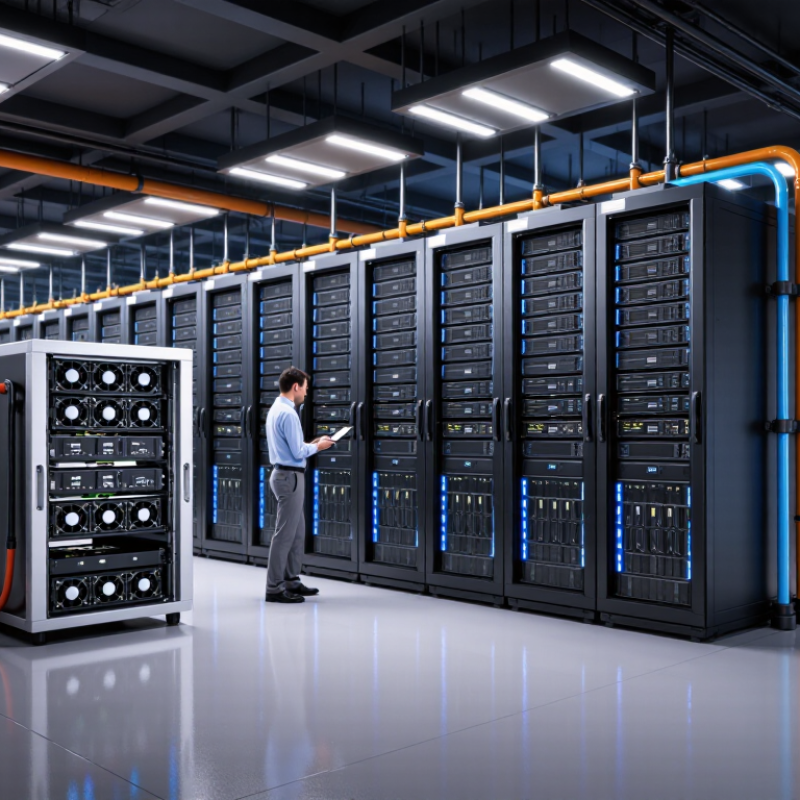
AI server manufacturers design and assemble computing systems built for machine learning, generative AI, simulation, and large-scale data analysis. Their work includes accelerator integration, high-speed networking, memory configuration, thermal design, firmware, and lifecycle support. A conventional server may run business software efficiently. An AI server must move enormous datasets between processors with minimal delay. That difference changes procurement decisions.
The market is expanding quickly. TrendForce projected global AI server shipments would grow by about 28% in 2025, supported by generative AI infrastructure demand. IDC’s Worldwide AI and Generative AI Spending Guide also forecasts strong growth in AI infrastructure investment through 2028. These figures show why manufacturers now serve cloud operators, research laboratories, financial institutions, healthcare organizations, and industrial enterprises. Their role is broader than hardware assembly. They help buyers validate workloads, power capacity, cooling systems, security controls, and regional compliance requirements.
The boundary is still messy. Some manufacturers develop complete systems, while others integrate components from specialized suppliers. Buyers should examine benchmark methods, warranty terms, deployment records, and energy use rather than trust headline performance. Forecasts are not promises. Actual results depend on software maturity, electricity availability, data quality, and technical staffing. The market scope therefore includes servers, infrastructure services, testing, maintenance, and responsible deployment. Gartner and IDC both emphasize that AI value depends on operational readiness, not hardware spending alone. That warning deserves more attention.
| Evaluation Dimension | 2026 Market Definition or Typical Data | Role in AI Server Procurement | Recommended Buyer Verification Points |
|---|---|---|---|
| AI Server Definition | A purpose-built compute system optimized for machine learning, deep learning, generative AI, high-performance computing, or accelerated data analytics. | Provides the compute, memory, storage, networking, and thermal infrastructure required to train, fine-tune, and deploy AI models. | Confirm accelerator compatibility, host-CPU capability, memory bandwidth, power design, cooling method, and software support. |
| Primary Market Segments | Cloud service providers AI research centers Enterprises Universities Government labs Industrial edge sites | Supports centralized model training, private AI platforms, inference services, scientific simulation, and on-site intelligent applications. | Match the manufacturer’s deployment experience, service network, security process, and integration capability to the buyer’s operating environment. |
| Typical Server Form Factors | Common formats include 1U, 2U, 4U, and larger multi-node chassis. Higher accelerator density generally requires more rack space and stronger power and cooling infrastructure. | Determines rack utilization, expansion options, serviceability, and total data-center deployment cost. | Check rack depth, rail compatibility, front-to-back airflow, node replacement procedure, and available expansion positions. |
| Accelerator Density | Typical configurations range from 1–2 accelerators for inference and development to 4–8 or more accelerators for large-scale training, depending on thermal and power limits. | Directly affects model-training throughput, inference concurrency, and cost per workload. | Verify accelerator form factor, double-width or single-width clearance, interconnect topology, power connectors, and supported firmware. |
| Host CPU and System Memory | AI servers commonly use one- or two-socket data-center CPUs with large DDR5 memory capacities. High-memory configurations may reach several hundred gigabytes or multiple terabytes per server. | Feeds data to accelerators, handles preprocessing, supports virtualization, and manages distributed workloads. | Review CPU core count, memory channels, maximum supported memory, NUMA layout, PCIe lane allocation, and memory error correction. |
| Accelerator Interconnect | High-performance systems may use direct accelerator links or high-bandwidth PCIe-based designs. Multi-server clusters commonly use 100GbE, 200GbE, 400GbE, or equivalent high-speed fabric options. | Reduces communication bottlenecks during distributed training and large-model inference. | Request a topology diagram showing accelerator-to-accelerator, accelerator-to-CPU, and server-to-switch paths. |
| Local Storage | NVMe solid-state storage is widely used for operating systems, containers, datasets, checkpoints, and high-speed scratch space. Capacity commonly ranges from several terabytes to tens of terabytes per node. | Improves dataset loading, checkpoint recovery, container startup, and local inference performance. | Check NVMe interface generation, drive endurance rating, RAID options, hot-swap support, and compatibility with shared storage. |
| Network Connectivity | Management networks often use 1GbE or 10GbE, while AI data paths commonly use 25GbE, 100GbE, 200GbE, or 400GbE in clustered environments. | Supports dataset transfer, distributed training, remote storage access, monitoring, and inference traffic. | Evaluate port count, switch compatibility, congestion control, RDMA support where required, transceiver availability, and cabling standards. |
| Power Envelope | AI servers may range from several hundred watts for compact inference systems to several kilowatts for dense multi-accelerator platforms. Actual consumption depends on workload and configuration. | Determines rack capacity, operating expense, power-distribution design, and sustainability performance. | Request typical and peak power figures, power-supply redundancy, input-voltage requirements, power-capping options, and efficiency test conditions. |
| Cooling Architecture | Air cooling remains common for lower-density systems. Direct-to-chip liquid cooling and other liquid-based designs are increasingly relevant for high-density AI deployments. | Maintains reliable operation when accelerator heat density exceeds the practical limits of standard air cooling. | Confirm facility water conditions, coolant distribution requirements, leak detection, service procedures, and retrofit requirements. |
| Software and Management | Typical software layers include Linux, container runtimes, orchestration platforms, accelerator drivers, monitoring tools, firmware management, and remote server administration. | Reduces deployment time and improves cluster utilization, diagnostics, security, and lifecycle management. | Verify driver and framework support, automated provisioning, API availability, remote console functions, firmware update policy, and logging. |
| Reliability and Serviceability | Enterprise AI servers generally use ECC memory, redundant power options, hot-swappable components, remote management, and replaceable storage or fan modules where supported. | Minimizes downtime and simplifies maintenance in continuous-training or production-inference environments. | Compare warranty coverage, spare-parts availability, response time, local service capability, mean-time-to-repair targets, and escalation procedures. |
| Security Requirements | Relevant controls may include secure boot, hardware root of trust, signed firmware, role-based management, encrypted storage, network isolation, and audit logging. | Protects models, training data, credentials, intellectual property, and regulated workloads. | Request security documentation, vulnerability-response procedures, firmware signing practices, access-control features, and compliance evidence. |
| International Compliance | Depending on the destination and configuration, buyers may require electrical safety, electromagnetic compatibility, environmental, energy-efficiency, import, and radio-related conformity documentation. | Supports lawful import, installation, operation, and resale across different countries and regions. | Confirm destination-specific declarations, test reports, labeling, power-cord requirements, customs documentation, and restricted-component screening. |
| Manufacturer Integration Capability | Strong manufacturers typically provide system design, accelerator integration, validation, rack-scale deployment, cluster configuration, and post-sales technical support. | Reduces interoperability risk when servers, switches, storage, cooling, and software must operate as one platform. | Request reference architectures, workload validation results, burn-in procedures, acceptance-test templates, and integration responsibility matrices. |
| Best-Fit Buying Scenario | Training cluster Inference node Private AI cloud HPC system Edge AI | Different workloads require different balances of accelerator count, memory capacity, network bandwidth, storage performance, power density, and serviceability. | Select based on measured workload performance and total cost of ownership rather than accelerator count alone. |
An AI server manufacturer designs systems for machine learning, simulation, and large-scale data analysis. It integrates accelerators, memory, networking, firmware, cooling, and support services. The work goes beyond assembly.
An AI server moves massive datasets between processors with very low delay. It usually needs stronger accelerators, faster interconnects, larger memory, and advanced cooling. Peak speed misleads.
Cloud operators, research laboratories, financial institutions, healthcare groups, and industrial companies use them. Their needs differ widely. A language model, medical simulation, and image system may require different configurations.
Compare verified performance, memory capacity, interconnect bandwidth, storage speed, cooling, and service response. Request tests using your models, batch sizes, and data pipelines. A polished datasheet is not enough.
A pilot can reveal throttling, software conflicts, noise, and unexpected power use. Run the system for at least two weeks when possible. Warm rooms expose weaknesses.
Ask about rack density, airflow, liquid-cooling needs, electricity use, and maintenance procedures. A dense rack may exceed the site’s power or cooling capacity. One failed power module can stop a cluster.
Review warranty coverage, spare-part locations, firmware policies, technician response times, and upgrade options. Regional support may affect repair speed and operating risk. Small details matter.
Forecasts show market direction, but they do not guarantee actual results. Performance depends on software maturity, data quality, electricity, cooling, and technical staff. I would challenge optimistic assumptions.
Include purchase price, electricity, cooling, maintenance, software compatibility, and future upgrades. A cheaper server may create higher operating costs later. The lowest quote is not always economical.
This guide explains the role and market scope of AI server manufacturers in 2026, focusing on how specialized systems support machine learning, deep learning, data analytics, and other demanding workloads. It introduces the key technologies used in modern AI servers, including accelerator-based computing, high-speed memory, advanced cooling, scalable networking, energy-efficient designs, and intelligent management tools. These technologies help organizations process larger datasets, train models faster, and operate reliable infrastructure across different environments.
The article also presents how global buyers can evaluate the top ai server manufacturers by comparing computing performance, configuration flexibility, product reliability, technical support, total cost of ownership, delivery capability, and long-term service. In addition, it highlights important international purchasing factors such as warranty coverage, system compatibility, data-center requirements, energy efficiency, documentation, and compliance with applicable regulations. This approach enables buyers to select AI server solutions that balance performance, budget, operational stability, and future scalability.
